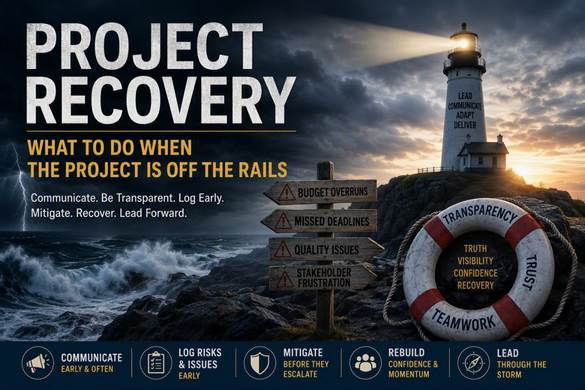
No project leader wants to start off a project expecting it to go off the rails. I know I for sure do not want any project to fall behind schedule, exceed its budget, miss delivery milestones, or not meet stakeholder needs. Yet if one has managed projects long enough, one will eventually face a project that feels like it is coming apart at the seams uncontrollably. This does happen though as deadlines slip, costs increase, defects are found, and confidence in the result erodes.
The true test of a project leader is not how we perform when everything is going according to plan… It is how we respond when it isn’t going well at all!
Over my many years of project leadership experience, I have learned that project recovery is not about taking heroic action, it is about disciplined leadership and communication. The foundation of recovery is not found in a revised schedule and new milestones which begins with transparency and the courage to tell the truth early and often.
The First Rule of Recovery: Stop Pretending Everything Is Fine
One of the biggest mistakes project teams make is delaying difficult conversations regarding the implementation.
- If a milestone gets missed, but the team assures stakeholders they can “make it up later” that needs to be said to those noted in the RACI.
- If costs begin trending upward, but no one wants to raise concerns until they have more data it could impact future trust in estimates and budgets.
- If quality issues emerge, but are treated as isolated incidents rather than symptoms of a larger problem then customers may not trust the result.
These delays or avoidance in communication often cause more damage than the original issue did or would have.
As I discussed in my blog, What Do Project Leaders Do? We Communicate and Translate, one of the most important responsibilities of a project leader is ensuring that information flows clearly and accurately across all levels of the organization.
Stakeholders Can Often Handle Bad News
What stakeholders do struggle with is bad news delivered too late for whatever reason that may be. When a project begins to drift off course, its leader must create visibility instead of hiding uncertainty as transparency creates short-term discomfort, but it preserves long-term trust.
Recovery Starts with an Honest Assessment
Before solving problems, we need to understand them through analysis. Many struggling projects become mired in a cycle of activity to recover rather than analysis first. Teams work longer hours, add more meetings, and increase pressure without first identifying the actual causes of failure.
To assist in generating a root cause (through RCA) it works to ask these difficult questions and more.
- Why are deadlines being missed?
- Why are costs increasing?
- Why are defects appearing?
- Why are stakeholders losing confidence?
- What assumptions were incorrect?
- What changed since project initiation?
Sometimes the root cause is poor estimation, and others might be resource constraints. Sometimes requirements were not fully understood from the start, and the project team might never have been provided with the information required to succeed.
Understanding the “why” matters far more than assigning blame. As explored in Project Leadership Unlocked: Accurate Project and Task Estimations and Project Estimation: Turning Uncertainty into a Shared Understanding, inaccurate assumptions made early often compound into much larger problems later.
The Risk Register Is Not a Mere Compliance Exercise
One common pattern I have noticed in other projects is that many of the issues that cause disruption were visible long before they became crises. I mean, the warning signs were there and may have been ignored. The project simply failed to capture or act on them early and often. This is why risk management cannot be treated as a one-time planning exercise.
In Project Leadership Unlocked: Risk Management, I discussed the importance of identifying uncertainties before they become problems. Most effective project leaders continuously evaluate risks and actively monitor them throughout a project lifecycle.
More importantly, risks and issues should be documented early and reviewed frequently. This is because a healthy project culture encourages team members to raise concerns immediately and not to disguise them. The goal is not to eliminate all risks as much as it is to identify them while mitigation remains possible.
Gregory Scott Wall: “The most expensive issues are those that everyone suspected but nobody logged.”
Risks Become Issues
A project recovery effort often reveals that:
- Resource availability risks became staffing issues.
- Estimation risks became schedule delays.
- Technical risks became quality defects.
- Stakeholder engagement risks became stakeholder resistance.
The earlier concerns are documented and discussed, the more options a team has available for mitigation.
Rebuilding Stakeholder Confidence
When projects go off the rails, stakeholder confidence is often damaged faster than the schedule itself is progressing.
It is always important to note and remember that trust is difficult to earn but easy to lose. The temptation during recovery is to provide aggressive projections and optimistic forecasts in an effort to reassure leadership. This rarely works and confidence is rebuilt through predictability.
Stakeholders want to and need to know:
- What happened?
- What is being done about it?
- What decisions are needed?
- When will they receive the next update?
- What results are we expecting?
- Where they can support.
They do not need perfection, as much as they need honesty. In Stakeholders Want to Be Heard: Include Them in Discovery, I discussed the value of bringing stakeholders into the conversation early. During recovery, this becomes even more critical as projects are rarely rescued through communication alone, but they almost always fail when communication breaks down.
Quality Problems Are Usually Leadership Problems First
When deliverables begin failing testing cycles, defects increase, or rework grows significantly, organizations often focus exclusively on fixing the technical issues. All of that while technical fixes are necessary, leaders should also ask larger questions that reach throughout the organization.
- Was sufficient testing planned?
- Were timelines compressed?
- Were requirements understood?
- Did resource constraints force shortcuts?
- Did supplier changes impact the result?
- Were contracts written incorrectly from the start?
These themes connect directly to ideas discussed in:
- Project Leadership Unlocked: The Testing Challenge
- Testing for Success Means Trying to Break It
- Gaps or Defects in Systems Being Implemented
Quality failures rarely appear suddenly:
- They are often the cumulative result of decisions made throughout the project lifecycle.
- Recovery requires addressing both the symptoms and the causes.
Leading Under Pressure
Perhaps the most challenging aspect of project for any project leader or team is that recovery is an emotional pressure.
- Executives want answers and now!
- Stakeholders want results ASAP!
- Teams become frustrated and exhausted because of stressors.
The project leader often feels caught between competing expectations. This is where leadership matters most as noted in Project Leadership Unlocked: The Most Difficult Things a Project Manager Is Responsible For, I discussed how project leadership extends far beyond schedules and task tracking.
During recovery, leaders must:
- Remain calm when others panic.
- Provide clarity amid uncertainty.
- Focus teams on solutions rather than blame.
- Protect morale without hiding reality.
- Create accountability without creating fear.
Strong project leaders acknowledge challenges openly while maintaining confidence that recovery is possible and planned. Those that lead well do not pretend the storm does not exist; they help everyone navigate through it. As I explored in Project Leadership: Navigating the Storm, leadership is most visible during difficult moments.
A Practical Recovery Framework
When facing a troubled project, I often come back to a simple sequence as noted below.
1. Tell the Truth: Establish a clear picture of current project health.
2. Identify Root Causes: Separate symptoms from underlying problems.
3. Update Risks and Issues: Document everything and ensure ownership is assigned.
4. Rebuild the Plan: Adjust scope, timeline, resources, or expectations based on reality.
5. Communicate Frequently: Create predictable reporting and stakeholder engagement.
6. Focus on Incremental Wins: Small successes help rebuild confidence and momentum.
7. Capture Lessons Learned: Recovery efforts generate valuable insights that should inform future projects.
8. Apply Lessons Learned: During future projects and implementations teams and project leaders should reference what was documented in the past because history repeats itself.
This final steps align closely with the principles discussed in Lessons Learned and Retrospectives: The Wisdom We Choose to Keep.
Final Thoughts
Projects do not fail because challenges appear, risks surface, or issues arise. Projects fail because any or all of those are hidden, unaddressed, or ignored for too long. The best project leaders understand that recovery from a hinderance begins with transparency of communication. We create environments where risks are logged early, issues are surfaced quickly, and difficult conversations happen before problems become crises because any of these can and will happen.
- Budgets are overrun
- Milestones are missed
- Concerns of quality show up
Stakeholder frustrations are serious challenges but none of them are as dangerous as the illusion that everything is fine and dandy. Successful project recovery is not merely about restoring a perfect plan or documenting that it happened. Ultimately, it is about rebuilding trust, restoring visibility, and leading people forward when confidence has been shaken. All of that starts with communicating the truth, even when it is difficult to hear.