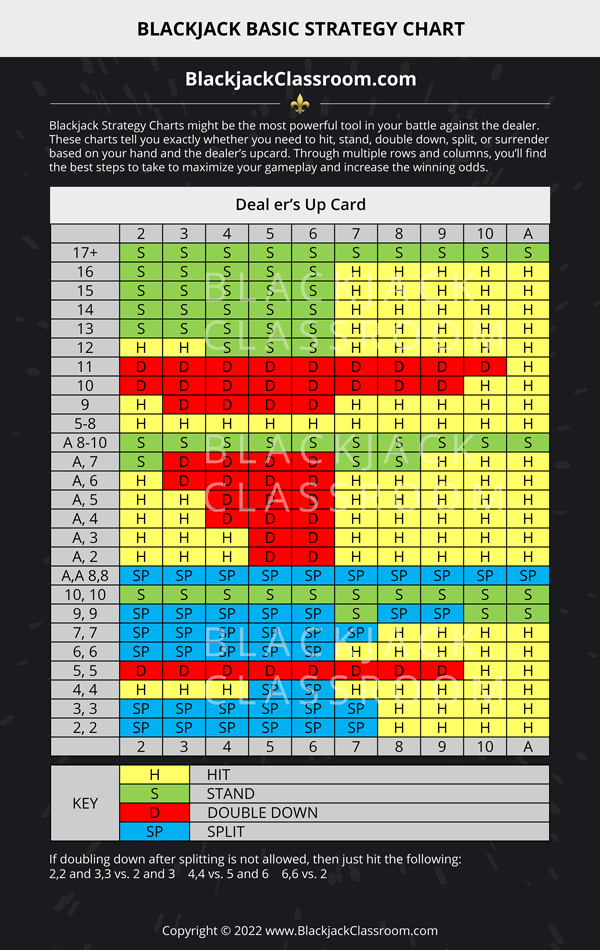
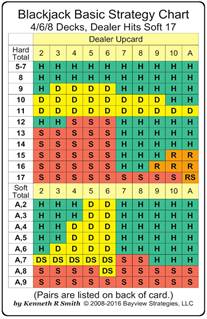
In blackjack, discipline and consistency are everything to ensure you remain sane and best your chance of ‘winning’. If you follow this proven set of rules, you eliminate second-guessing and regret which erodes your beingness. The key is to trust the strategy! Do not attempt to use your emotions or ‘gut’ when playing Blackjack. When a hand doesn’t go your way, don’t blame yourself instead, evaluate whether your play or your rules need refining.
This blog outlines a structured approach to Blackjack that prioritizes smart play, bankroll management, and strategic positioning at the table.
Basic Blackjack Guidance
- Bankroll Discipline
Never sit down at a blackjack table with less than 20 times the minimum bet. This gives you the cushion to ride out losing streaks and capitalize on winning runs. Playing just a few hands is never a reliable measure of success, longevity is key.
- Positioning: Sit at Third Base
Always aim to sit at third base which is the last seat to act before the dealer plays. This position gives you a view of how other players are playing and the ability to influence the dealer’s next card based on your decision to hit or stand.
- Table Selection Based on Payouts
Only play at tables that pay 3:2 on blackjack. Avoid 6:5 payout tables as they’re designed to increase the house edge and reduce long-term player profitability.
- Comfort and Control
If you feel uncomfortable at a table due to the dealer, other players, or the vibe you should leave it immediately. Don’t wait for things to improve as your mindset impacts your own play and its results.
- Bet Consistency
Never change your bet amount mid-session at a single table. By increasing or decreasing your bet based on emotions or hope you will begin second guessing losing focus. If you want to change your bet size, change tables to start fresh with that adjusted amount. If the table minimum changes, mid-play, casinos often “grandfather” your lower bet, but this is not guaranteed.
Playing Guidelines
- Assume the Dealer Has a Downcard of 10
Always assume the dealer’s hidden card is a 10-value card. With 10s and face cards making up 31% of the deck, this assumption helps you make smarter decisions.
- Assume the Next Card is a 10
When deciding whether to hit or double down, assume the next card dealt will be a 10. This mindset helps you avoid risky plays like doubling on 12 and anticipate busts.
- Never Take Insurance
When the dealer shows an Ace as their upcard, never take insurance. It’s a statistically poor bet over time and favors the house.
- Always Take Even Money
If you have a blackjack and the dealer shows an upcard of an Ace, take even money. This guarantees a payout and avoids a push (tie), which pays you nothing.
- Hit When You Can’t Bust
Always hit, split, or double down when your hand totals 11 or less. You cannot bust, so take advantage of the opportunity to strengthen your hand by taking well deserved additional cards.
- Don’t Hit Against Dealer Bust Cards
If the dealer’s upcard is a bust card (3, 4, 5, or 6), do not hit if your hand is 12 or higher. Let the dealer bust themselves by getting the 10.
- Hit 12 Against a “Dealer’s Ace”
If the dealer’s upcard is a 2, do not hit if your hand is 13 or higher. That means if you have a 12 also, you should hit.
Maximizing Your Bets
When the odds are in your favor, get more money on the table and here’s how:
- Never Split cards that start with the letter “F”: That means not to split on Fours, Fives, or Face cards (including 10s)
- Splitting 4s or 5s often leads to two weak hands
- Splitting two 5s (or 10) ruins a strong hand (20) by getting two 15s instead
- No one wants two 14s when they could have had an 18
- Splitting 4s or 5s often leads to two weak hands
- Always Double down on 11, regardless of the dealer’s upcard
- Hit on 12 through 16 if the dealer shows a 7, 8, 9, 10, Face, or Ace
- Since you are already losing, why not take a chance that you can beat them
- Double down on 10 if the dealer shows 9 or less. only after they’ve checked and don’t have blackjack
- Double down on 9 if the dealer shows a bust card of 3, 4, 5, or 6
- Double down on soft hands of A2, A3, A4, A5, A6, or A7 if the dealer shows a bust card (anything between a 3 and 6)
- Always Split Aces and 8s, no matter what the dealer shows, since the odds
- Split 2s, 3s, 6s, 7s, and 9s when the dealer shows a bust card of 3, 4, 5, or 6
- Split 9s when the dealer shows a 7 or 8
Advanced Tip: Play Two Hands
Consider playing two hands at once. This strategy lets you see more cards and increases your chances of pushing. It also reduces the number of other players at the table.
Note: You may need to bet at least twice the minimum per hand, so bankroll discipline is essential.
Key Blackjack Definitions
Dealer Upcard: The visible card dealt to the dealer
Dealer Downcard: The hidden card dealt to the dealer
Bust Card: Dealer upcard that increase the chance of busting (2–6)
Ace: Counts as 1 or 11, depending on the hand
Face Card: Jack, Queen, or King—each worth 10
Hit: Request another card
Push: Tie between player and dealer which no win or loss for you
Stand/Stay: Keep your current hand (do not take more cards)
Double Down: Double your bet and receive one more card
Split: Divide a pair into two separate hands
Insurance: Side bet against dealer blackjack (not recommended)
Natural blackjack: When your first two cards are an Ace and a 10-value card
Dealer’s Ace: Okay, a dealer showing their upcard as a 2, is a really good card for the dealer so some have named it the “Dealer’s Ace”
Even Money: Guaranteed 1:1 payout when you have blackjack and the dealer shows an Ace
Shoe: Device holding multiple decks of cards
Third Base: Last player to act before the dealer
Soft 17: A hand totaling 17 with an Ace counted as 11 (e.g., A+6)
3:2 payout: Refers to the amount you win when you’re dealt a natural blackjack being 1.5 times your original amount
6:5 payout: refers to the amount you win when you’re dealt a natural blackjack. Unlike the traditional 3:2 payout, which gives you $15 on a $10 bet, a 6:5 payout only gives you $12 for the same bet.
Sources of Blackjack Strategy and Learning
- Pagat Blackjack Guide
- Wikipedia: Blackjack
- Blackjack Basic Strategy Chart
- Strategy Cards: Available online or in casino gift shops